

Article & News

Category: Blog

Blog
How to Choose an Efficient Heatsink for AI Servers: From Materials to Structure

Introduction

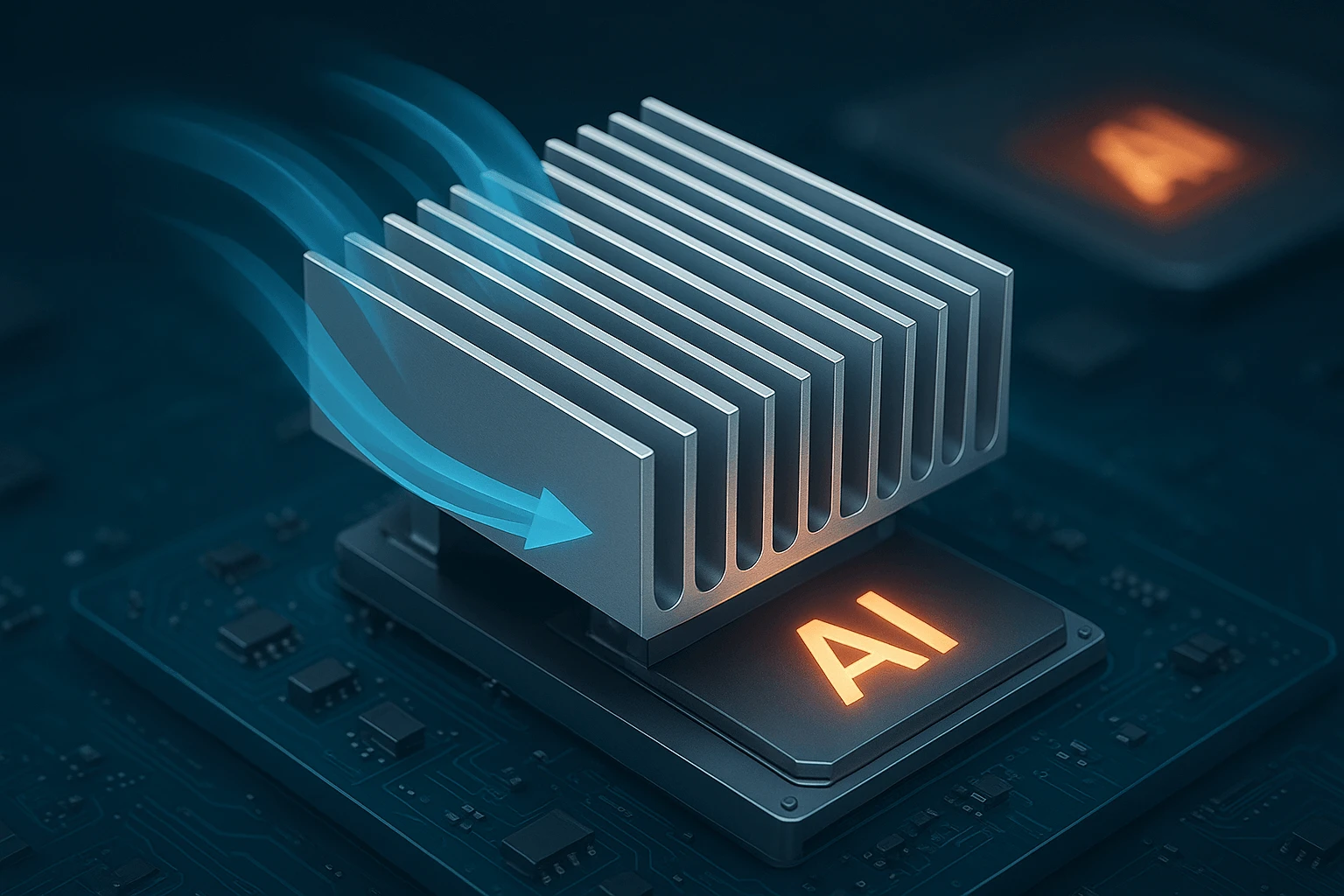
Artificial Intelligence (AI) has become the backbone of modern computing, powering data centers, autonomous vehicles, medical research, and countless applications that demand high computational capacity. Behind every AI server lies an essential but often overlooked component: the heatsink. Without efficient cooling, the most advanced AI chips can quickly lose performance or even fail due to overheating. Choosing the right heatsink for AI servers is no longer a minor design decision—it is a strategic step that determines system reliability, energy efficiency, and long-term cost savings.

This article explores how to select an efficient AI heatsink, with a focus on material choices, structural design, and industry best practices.

Why AI Servers Require Advanced Cooling Solutions
Unlike traditional workloads, AI servers run continuous, high-intensity calculations involving large datasets and parallel GPU or TPU operations. This creates a dense thermal load concentrated in a compact space. A poorly designed cooling system leads to:

Performance throttling due to overheating
Reduced lifespan of AI hardware
Higher power consumption from inefficient thermal management
Increased maintenance and downtime
Therefore, a well-designed AI heatsink is not only about cooling—it directly influences productivity and operational costs.

Key Materials for AI Heatsinks
The choice of material plays a defining role in thermal conductivity, durability, and manufacturing cost.

Aluminum
High thermal conductivity with relatively low weight
Cost-effective for large-scale production
Suitable for extrusion profiles, allowing flexible designs
Copper
Superior heat transfer efficiency
Heavier and more expensive than aluminum
Commonly used in hybrid heatsinks for hotspot management
Advanced Alloys & Composites
Combine lightweight features with high thermal conductivity
Increasingly popular in AI heatsink manufacturing where efficiency per unit weight matters
The trend is moving toward hybrid heatsinks where copper bases manage hotspots, and aluminum fins dissipate heat across larger areas.

Structural Design Considerations
A heatsink’s performance does not only depend on the material—it also relies on structural engineering.

Fin Density and Shape: More fins increase surface area but may obstruct airflow. Balancing density with ventilation efficiency is essential.
Surface Treatment: Anodizing and coating improve durability and radiation heat transfer.
Contact Surface Precision: The tighter the contact with the AI chip, the lower the thermal resistance. CNC machining ensures accuracy.
Active vs Passive Cooling:
Passive heatsinks rely on natural convection, best for lower power modules.
Active heatsinks use fans or liquid cooling channels, ideal for high-performance AI servers.
Comparing Cooling Technologies
As AI workloads expand, manufacturers are exploring innovative cooling strategies:

Traditional Air Cooling: Cost-effective but limited for high-density servers.
Heat Pipes & Vapor Chambers: Transfer heat quickly across surfaces, improving hotspot management.
Liquid Cooling: Increasingly adopted for next-gen AI data centers where air cooling is insufficient.
For most AI servers today, a combination of air cooling with copper baseplates or vapor chambers is the practical balance between performance and cost.

Industry Applications and Case Studies
Data Centers: Massive AI clusters require scalable heatsinks optimized for airflow within server racks.
Edge AI Devices: Compact devices in autonomous cars and IoT rely on lightweight yet efficient heatsinks.
Medical AI Systems: High-performance computing in imaging and diagnostics demands precision-machined heatsinks to guarantee stability.
These examples show that there is no one-size-fits-all solution—customization is the key to optimal performance.

Future Trends in AI Heatsink Development
Integration with AI chips: Future designs will move toward embedded thermal management.
Lightweight composites: Combining graphene and advanced alloys for extreme conductivity.
Smart cooling systems: IoT-enabled heatsinks that adapt cooling in real time.
As AI applications evolve, so too will the demand for custom CNC heatsink solutions.

Conclusion: Why Custom CNC Heatsinks Are the Future
Efficient cooling is the hidden enabler of AI innovation. The right heatsink ensures stability, reduces energy costs, and extends the lifespan of critical AI infrastructure. Choosing between materials, structural designs, and cooling technologies requires careful consideration of application needs.

At, we specialize in custom CNC machining for AI heatsinks. Our team works closely with clients—from reviewing technical drawings to offering cost-effective manufacturing solutions. By combining precision machining with industry expertise, we ensure every heatsink matches exact performance requirements.

If you provide the design drawings, we will deliver the best quotation and tailored service to help you build efficient, reliable, and future-ready AI systems.
Blog
Edge Computing for Real-Time CNC Process Control

Introduction
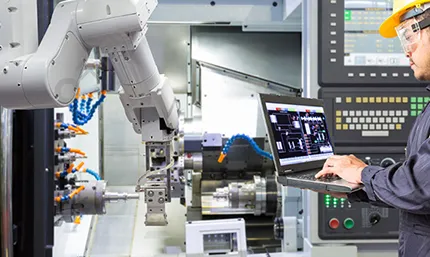
Traditional CNC controllers focus strictly on tool motion and G-code execution, but advanced analytics—like collision detection or spindle load estimation—can overload them. Edge computing offers a high-performance solution by processing data nearby, without adding strain to the CNC controller itself. This enables real-time feedback and optimization, without compromising machine performance.

1. What Is Edge Computing in a CNC Context?
Edge computing places rugged industrial PCs or micro-servers near CNC machines to capture spindle load, axis speed, sensor data, and look-ahead calculations. These edge devices run predictive models locally and offer actionable feedback—alerts, tool-change triggers, or feed hold commands—without burdening the CNC controller.

2. How Edge Devices Offload CNC Controllers
Because edge devices operate independently, they reduce computation overhead on CNC controllers by >95%. Siemens reports that edge analytics capture “look ahead” tool movement and compare it against 3D machine models to preempt collisions without downtime or latency.

3. Use Cases: Collision Avoidance, Tool Wear Alerts, Machine Balancing
Collision Avoidance: Edge compares upcoming moves with CAD fixture models and automatically halts motion if risk is detected.
Tool Wear Prediction: Real-time spindle vibration and load curves trigger change requests when thresholds are exceeded—before tool failure occurs.
Machine Personalities: By comparing machines, deviations are caught early—enabling predictive maintenance or recalibration, improving uniformity across a cell.
4. Practical Implementation Steps and Best Practices
Deploy Rugged Edge Units next to each CNC machine.
Use Open Standard Protocols like MTConnect or OPC UA to feed data reliably.
Train predictive models using historical data under variable loads.
Integrate Feedback to dispatch MQTT feed-hold or repair alerts directly into operator dashboards—without interfering with G-code execution.
5. Return on Investment and Performance Gains
Shops implementing edge compute for CNC have seen a 30% reduction in setup scrap and 15% boost in uptime. Siemens case studies show tools operate longer before replacement, offering cost savings. Running advanced analytics on edge devices rather than PLC or CNC avoids system slow-downs and downtime.

6. Cybersecurity & Integration with IT Systems
Edge infrastructure introduces new network endpoints. Best practices include VLAN segmentation, encrypted MQTT or OPC UA over TLS, and secure authentication to ensure CNC controllers remain isolated from enterprise browsing or email traffic.

Why Choose Formal CNC for Edge-Based CNC Optimization?
Formal CNC provides tailored edge-compute solutions that integrate smart analytics into your CNC operations—without disruption. From selecting edge hardware and modeling tool wear to system deployment and operator training, we deliver automated optimization with ROI. Contact us to design your smart CNC foundation.

Blog
Cybersecurity for Networked CNC Systems

1. Why CNC Machines Are High‑Risk Targets
As factories adopt more IIoT-connected equipment, CNC machines—often running legacy Windows or Linux—have become vulnerable endpoints. According to Trend Micro, once they connect to IT networks, CNC controllers risk remote code execution, parameter tampering, and even human harm: disabling safety features like “feed hold” can cause serious injuries. The interconnectedness also means a single phishing click in an office can cascade into the shop floor, making CNC systems an attractive target for both sabotaging operations and intellectual property theft .

2. Types of Cyber Threats Facing CNC Cells
Remote Code Execution (RCE): Exploits on adversary-vulnerable protocols or command interfaces can allow full control over CNC actions .
Ransomware & Locker Attacks: Malware that locks the interface—or entire network—turns shop cells into corporate hostages. Recent threats like LockBit have targeted manufacturing, holding essential systems until ransom is paid.
Intellectual Property Theft: Attackers may harvest CNC files, toolpaths, and proprietary machining instructions to replicate or sell processes .
Disruption by False Data Injection: Tampering with sensor feedback, load thresholds, or machine settings can cause hidden faults—producing scrap or dangerous overcuts.
3. Technical Controls: Network Segmentation & Access Management
Isolate CNC Machines: Use dedicated VLANs or physical separation to shield CNC controllers from enterprise IT traffic.
Strong Access Controls: Replace default credentials, implement multifactor login, and grant minimal privilege only to essential accounts .
Encrypted Communication: Apply TLS or VPN tunnels for remote sessions; avoid clear-text protocols that attackers can passively intercept .
4. Monitoring, Patch Management & Intrusion Detection
ICS-Aware Firewalls: Deploy intrusion prevention and anomaly detection tools tailored for industrial environments .
Regular Updates: Keep control firmware patched and audit outdated CNC systems. Legacy machines without updates should be isolated from the network .
Log & Alert Systems: Monitor login attempts, network scans, downloads, and actuator anomalies. Graylog-style SIEM systems can integrate CNC logs for centralized visibility .
5. Training, Culture & Organizational Policies
Humans remain the weakest link. Yet fewer than half of shops train employees or mandate leadership involvement in cybersecurity. Cyber hygiene programs should begin with awareness campaigns, simple drills, and strong policy frameworks to create a security-conscious organization.

6. Aligning with Industry Standards: IEC 62443 & NIST
IEC 62443 offers a structured security approach for OT architecture, ranging from device authentication to secure development and patch policies.
NIST & NCCIC offer guidance and frameworks suited to US manufacturers, encapsulating risk management and situational-awareness tactics.
7. Real‑World Incidents & Lessons Learned
Marinette Marine ransomware (2023): Locking CNC instructions stalled naval production temporarily.
Synnovis attack (2024): Disrupted UK healthcare and contributed to patient harm—a stark reminder of real-world consequences.
Industry-wide vulnerabilities: Research alerts from Trend Micro and SecurityWeek highlight real threat vectors across CNC vendors like Haas, Okuma, and Fanuc.
8. Building a Cyber‑Resilient CNC Operation
Assess your shop’s IT/OT attack surface thoroughly.
Segment networks diligently—CNC should not share networks with email or browsing.
Enforce strong credential policies and rotate passwords regularly.
Implement ICS-aware security tools with real-time visibility.
Conduct regular drills, updates, and tabletop exercises.
Adopt standards like IEC 62443 and comply with audits.
Closing Thought:
As CNC shops elevate from stand-alone cell operations to networked Industry 4.0 environments, cybersecurity is no longer optional—it’s essential. Unsecured machines represent direct threats to production continuity, safety, and intellectual property. With a proactive defense strategy grounded in technology, training, and standards, CNC operations can safely embrace digital transformation.

Blog
Cybersecurity for Networked CNC Systems

1. Why CNC Machines Are High‑Risk Targets
As factories adopt more IIoT-connected equipment, CNC machines—often running legacy Windows or Linux—have become vulnerable endpoints. According to Trend Micro, once they connect to IT networks, CNC controllers risk remote code execution, parameter tampering, and even human harm: disabling safety features like “feed hold” can cause serious injuries. The interconnectedness also means a single phishing click in an office can cascade into the shop floor, making CNC systems an attractive target for both sabotaging operations and intellectual property theft .

2. Types of Cyber Threats Facing CNC Cells
Remote Code Execution (RCE): Exploits on adversary-vulnerable protocols or command interfaces can allow full control over CNC actions .
Ransomware & Locker Attacks: Malware that locks the interface—or entire network—turns shop cells into corporate hostages. Recent threats like LockBit have targeted manufacturing, holding essential systems until ransom is paid.
Intellectual Property Theft: Attackers may harvest CNC files, toolpaths, and proprietary machining instructions to replicate or sell processes .
Disruption by False Data Injection: Tampering with sensor feedback, load thresholds, or machine settings can cause hidden faults—producing scrap or dangerous overcuts.
3. Technical Controls: Network Segmentation & Access Management
Isolate CNC Machines: Use dedicated VLANs or physical separation to shield CNC controllers from enterprise IT traffic.
Strong Access Controls: Replace default credentials, implement multifactor login, and grant minimal privilege only to essential accounts .
Encrypted Communication: Apply TLS or VPN tunnels for remote sessions; avoid clear-text protocols that attackers can passively intercept .
4. Monitoring, Patch Management & Intrusion Detection
ICS-Aware Firewalls: Deploy intrusion prevention and anomaly detection tools tailored for industrial environments .
Regular Updates: Keep control firmware patched and audit outdated CNC systems. Legacy machines without updates should be isolated from the network .
Log & Alert Systems: Monitor login attempts, network scans, downloads, and actuator anomalies. Graylog-style SIEM systems can integrate CNC logs for centralized visibility .
5. Training, Culture & Organizational Policies
Humans remain the weakest link. Yet fewer than half of shops train employees or mandate leadership involvement in cybersecurity. Cyber hygiene programs should begin with awareness campaigns, simple drills, and strong policy frameworks to create a security-conscious organization.

6. Aligning with Industry Standards: IEC 62443 & NIST
IEC 62443 offers a structured security approach for OT architecture, ranging from device authentication to secure development and patch policies.
NIST & NCCIC offer guidance and frameworks suited to US manufacturers, encapsulating risk management and situational-awareness tactics.
7. Real‑World Incidents & Lessons Learned
Marinette Marine ransomware (2023): Locking CNC instructions stalled naval production temporarily.
Synnovis attack (2024): Disrupted UK healthcare and contributed to patient harm—a stark reminder of real-world consequences.
Industry-wide vulnerabilities: Research alerts from Trend Micro and SecurityWeek highlight real threat vectors across CNC vendors like Haas, Okuma, and Fanuc.
8. Building a Cyber‑Resilient CNC Operation
Assess your shop’s IT/OT attack surface thoroughly.
Segment networks diligently—CNC should not share networks with email or browsing.
Enforce strong credential policies and rotate passwords regularly.
Implement ICS-aware security tools with real-time visibility.
Conduct regular drills, updates, and tabletop exercises.
Adopt standards like IEC 62443 and comply with audits.
Closing Thought:
As CNC shops elevate from stand-alone cell operations to networked Industry 4.0 environments, cybersecurity is no longer optional—it’s essential. Unsecured machines represent direct threats to production continuity, safety, and intellectual property. With a proactive defense strategy grounded in technology, training, and standards, CNC operations can safely embrace digital transformation.

Blog
Cobots vs Traditional Robots in CNC Tending | CNC Automation Insights

Introduction
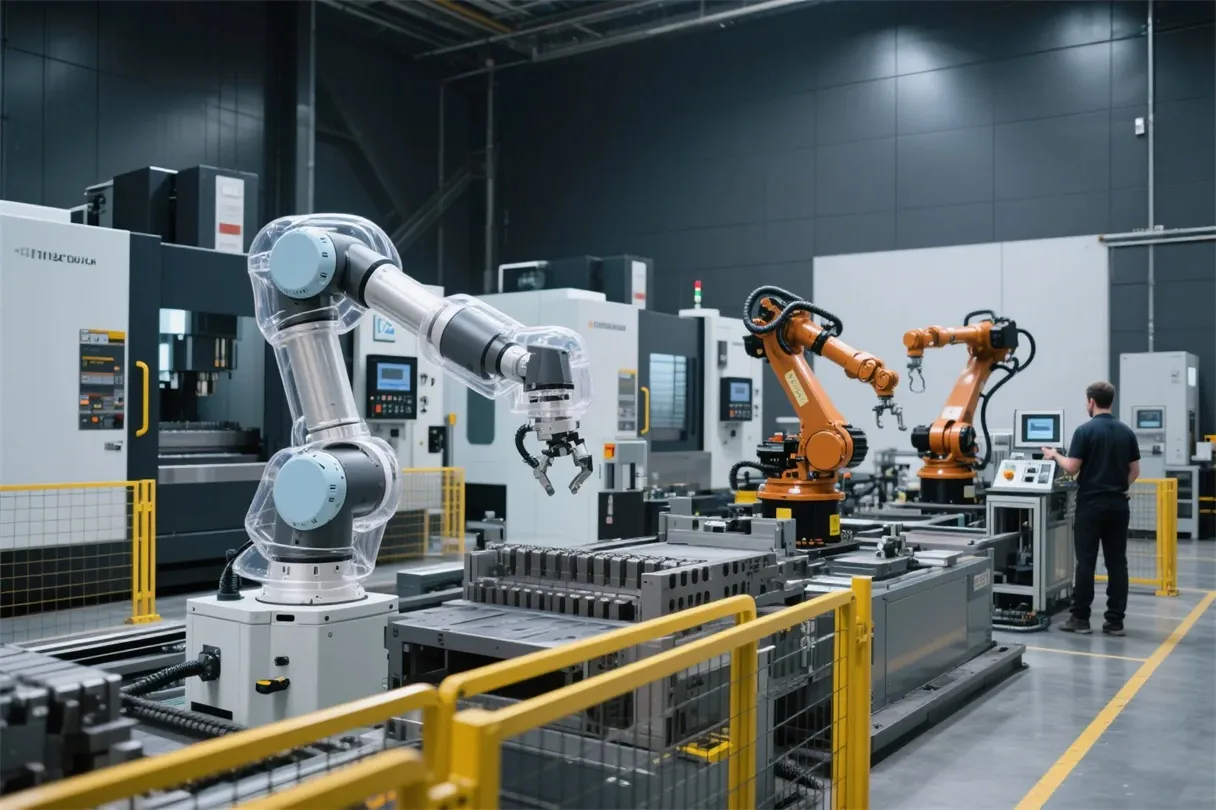
Machine tending—the process of loading and unloading CNC parts—is essential but often repetitive and labor-intensive. As CNC shops evolve, choosing between traditional robots and collaborative robots (cobots) is a pivotal automation decision. Each has distinct strengths and suitability depending on scale, complexity, and your workforce needs.

1. Understanding Machine Tending in CNC Environments
CNC machine tending requires consistent placement of raw material, tool changes, inspection, and unloading. Historically, skilled operators performed these tasks manually, causing downtime, variability, and fatigue. Automating this process boosts consistency and frees human workers for complex tasks.

2. Defining Traditional Robots vs Collaborative Robots (Cobots)
Traditional robots, typically caged and high-speed, demand expert programming and fixed installation. These systems are reliable for high-volume repetitive tasks but require safety enclosures and greater capital investment.
Cobots, on the other hand, are lightweight, sensor-equipped, and designed to work alongside humans without fences. They enable flexible deployment, easy programming, and lower cost of entry—ideal for high-mix, low-volume CNC shops.

3. Performance Metrics: Safety, Flexibility, and ROI
Safety: Cobots’ force sensors and safety-rated stops eliminate the need for fencing and reduce risk of injury.
Flexibility: Cobots can be repurposed across multiple cells quickly; traditional robots often tie firms to single workcells.
ROI: Cobots require lower initial investment (often 1/3–1/2 cost), faster deployment, and return on investment within month. Traditional robots deliver ROI over longer cycles, but suit high-speed, high-volume production.
4. Programming, Deployment and Reconfiguration Time
Cobots support intuitive programming—via drag-and-drop or manual teaching—reducing setup time dramatically. A line operator can often redeploy a cobot within hours. Traditional robots may require weeks of engineering, programming, and dedicated robot integrators.

5. Use Cases: SMEs vs High‑Volume Production Lines
SMEs and job shops benefit from cobots because of their flexibility and low investment barrier—e.g. prototyping, custom parts and lights-out cells.
Large automotive or electronics factories still rely on traditional robots for ultra-high-speed conveyor tending and large payloads.
6. Challenges, Limitations and Decision Criteria
Cobots have lower payload capacity and slower speeds; they struggle with heavy or high inertia parts. Traditional robots need more safety infrastructure and skilled personnel. Evaluate your process volumes, machinist availability, footprint, and part variety before deciding.

Why Choose Formal CNC for Your Automation Needs?
At Formal CNC, we specialize in designing and implementing custom cobot-based CNC tending cells that deliver optimal safety, flexibility, and ROI. From initial site survey to programming and integration, we offer turnkey solutions customized for your unique production line.

Blog
Cobots vs Traditional Robots in CNC Tending | CNC Automation Insights

Introduction
Machine tending—the process of loading and unloading CNC parts—is essential but often repetitive and labor-intensive. As CNC shops evolve, choosing between traditional robots and collaborative robots (cobots) is a pivotal automation decision. Each has distinct strengths and suitability depending on scale, complexity, and your workforce needs.

1. Understanding Machine Tending in CNC Environments
CNC machine tending requires consistent placement of raw material, tool changes, inspection, and unloading. Historically, skilled operators performed these tasks manually, causing downtime, variability, and fatigue. Automating this process boosts consistency and frees human workers for complex tasks.

2. Defining Traditional Robots vs Collaborative Robots (Cobots)
Traditional robots, typically caged and high-speed, demand expert programming and fixed installation. These systems are reliable for high-volume repetitive tasks but require safety enclosures and greater capital investment.
Cobots, on the other hand, are lightweight, sensor-equipped, and designed to work alongside humans without fences. They enable flexible deployment, easy programming, and lower cost of entry—ideal for high-mix, low-volume CNC shops.

3. Performance Metrics: Safety, Flexibility, and ROI
Safety: Cobots’ force sensors and safety-rated stops eliminate the need for fencing and reduce risk of injury.
Flexibility: Cobots can be repurposed across multiple cells quickly; traditional robots often tie firms to single workcells.
ROI: Cobots require lower initial investment (often 1/3–1/2 cost), faster deployment, and return on investment within month. Traditional robots deliver ROI over longer cycles, but suit high-speed, high-volume production.
4. Programming, Deployment and Reconfiguration Time
Cobots support intuitive programming—via drag-and-drop or manual teaching—reducing setup time dramatically. A line operator can often redeploy a cobot within hours. Traditional robots may require weeks of engineering, programming, and dedicated robot integrators.

5. Use Cases: SMEs vs High‑Volume Production Lines
SMEs and job shops benefit from cobots because of their flexibility and low investment barrier—e.g. prototyping, custom parts and lights-out cells.
Large automotive or electronics factories still rely on traditional robots for ultra-high-speed conveyor tending and large payloads.
6. Challenges, Limitations and Decision Criteria
Cobots have lower payload capacity and slower speeds; they struggle with heavy or high inertia parts. Traditional robots need more safety infrastructure and skilled personnel. Evaluate your process volumes, machinist availability, footprint, and part variety before deciding.

Why Choose Formal CNC for Your Automation Needs?
At Formal CNC, we specialize in designing and implementing custom cobot-based CNC tending cells that deliver optimal safety, flexibility, and ROI. From initial site survey to programming and integration, we offer turnkey solutions customized for your unique production line.

Blog
Edge Computing for Real-Time CNC Process Control

Introduction
Traditional CNC controllers focus strictly on tool motion and G-code execution, but advanced analytics—like collision detection or spindle load estimation—can overload them. Edge computing offers a high-performance solution by processing data nearby, without adding strain to the CNC controller itself. This enables real-time feedback and optimization, without compromising machine performance.

1. What Is Edge Computing in a CNC Context?
Edge computing places rugged industrial PCs or micro-servers near CNC machines to capture spindle load, axis speed, sensor data, and look-ahead calculations. These edge devices run predictive models locally and offer actionable feedback—alerts, tool-change triggers, or feed hold commands—without burdening the CNC controller.

2. How Edge Devices Offload CNC Controllers
Because edge devices operate independently, they reduce computation overhead on CNC controllers by >95%. Siemens reports that edge analytics capture “look ahead” tool movement and compare it against 3D machine models to preempt collisions without downtime or latency.

3. Use Cases: Collision Avoidance, Tool Wear Alerts, Machine Balancing
Collision Avoidance: Edge compares upcoming moves with CAD fixture models and automatically halts motion if risk is detected.
Tool Wear Prediction: Real-time spindle vibration and load curves trigger change requests when thresholds are exceeded—before tool failure occurs.
Machine Personalities: By comparing machines, deviations are caught early—enabling predictive maintenance or recalibration, improving uniformity across a cell.
4. Practical Implementation Steps and Best Practices
Deploy Rugged Edge Units next to each CNC machine.
Use Open Standard Protocols like MTConnect or OPC UA to feed data reliably.
Train predictive models using historical data under variable loads.
Integrate Feedback to dispatch MQTT feed-hold or repair alerts directly into operator dashboards—without interfering with G-code execution.
5. Return on Investment and Performance Gains
Shops implementing edge compute for CNC have seen a 30% reduction in setup scrap and 15% boost in uptime. Siemens case studies show tools operate longer before replacement, offering cost savings. Running advanced analytics on edge devices rather than PLC or CNC avoids system slow-downs and downtime.

6. Cybersecurity & Integration with IT Systems
Edge infrastructure introduces new network endpoints. Best practices include VLAN segmentation, encrypted MQTT or OPC UA over TLS, and secure authentication to ensure CNC controllers remain isolated from enterprise browsing or email traffic.

Why Choose Formal CNC for Edge-Based CNC Optimization?
Formal CNC provides tailored edge-compute solutions that integrate smart analytics into your CNC operations—without disruption. From selecting edge hardware and modeling tool wear to system deployment and operator training, we deliver automated optimization with ROI. Contact us to design your smart CNC foundation.

Blog
How to Choose an Efficient Heatsink for AI Servers: From Materials to Structure

Introduction

Artificial Intelligence (AI) has become the backbone of modern computing, powering data centers, autonomous vehicles, medical research, and countless applications that demand high computational capacity. Behind every AI server lies an essential but often overlooked component: the heatsink. Without efficient cooling, the most advanced AI chips can quickly lose performance or even fail due to overheating. Choosing the right heatsink for AI servers is no longer a minor design decision—it is a strategic step that determines system reliability, energy efficiency, and long-term cost savings.

This article explores how to select an efficient AI heatsink, with a focus on material choices, structural design, and industry best practices.

Why AI Servers Require Advanced Cooling Solutions
Unlike traditional workloads, AI servers run continuous, high-intensity calculations involving large datasets and parallel GPU or TPU operations. This creates a dense thermal load concentrated in a compact space. A poorly designed cooling system leads to:

Performance throttling due to overheating
Reduced lifespan of AI hardware
Higher power consumption from inefficient thermal management
Increased maintenance and downtime
Therefore, a well-designed AI heatsink is not only about cooling—it directly influences productivity and operational costs.

Key Materials for AI Heatsinks
The choice of material plays a defining role in thermal conductivity, durability, and manufacturing cost.

Aluminum
High thermal conductivity with relatively low weight
Cost-effective for large-scale production
Suitable for extrusion profiles, allowing flexible designs
Copper
Superior heat transfer efficiency
Heavier and more expensive than aluminum
Commonly used in hybrid heatsinks for hotspot management
Advanced Alloys & Composites
Combine lightweight features with high thermal conductivity
Increasingly popular in AI heatsink manufacturing where efficiency per unit weight matters
The trend is moving toward hybrid heatsinks where copper bases manage hotspots, and aluminum fins dissipate heat across larger areas.

Structural Design Considerations
A heatsink’s performance does not only depend on the material—it also relies on structural engineering.

Fin Density and Shape: More fins increase surface area but may obstruct airflow. Balancing density with ventilation efficiency is essential.
Surface Treatment: Anodizing and coating improve durability and radiation heat transfer.
Contact Surface Precision: The tighter the contact with the AI chip, the lower the thermal resistance. CNC machining ensures accuracy.
Active vs Passive Cooling:
Passive heatsinks rely on natural convection, best for lower power modules.
Active heatsinks use fans or liquid cooling channels, ideal for high-performance AI servers.
Comparing Cooling Technologies
As AI workloads expand, manufacturers are exploring innovative cooling strategies:

Traditional Air Cooling: Cost-effective but limited for high-density servers.
Heat Pipes & Vapor Chambers: Transfer heat quickly across surfaces, improving hotspot management.
Liquid Cooling: Increasingly adopted for next-gen AI data centers where air cooling is insufficient.
For most AI servers today, a combination of air cooling with copper baseplates or vapor chambers is the practical balance between performance and cost.

Industry Applications and Case Studies
Data Centers: Massive AI clusters require scalable heatsinks optimized for airflow within server racks.
Edge AI Devices: Compact devices in autonomous cars and IoT rely on lightweight yet efficient heatsinks.
Medical AI Systems: High-performance computing in imaging and diagnostics demands precision-machined heatsinks to guarantee stability.
These examples show that there is no one-size-fits-all solution—customization is the key to optimal performance.

Future Trends in AI Heatsink Development
Integration with AI chips: Future designs will move toward embedded thermal management.
Lightweight composites: Combining graphene and advanced alloys for extreme conductivity.
Smart cooling systems: IoT-enabled heatsinks that adapt cooling in real time.
As AI applications evolve, so too will the demand for custom CNC heatsink solutions.

Conclusion: Why Custom CNC Heatsinks Are the Future
Efficient cooling is the hidden enabler of AI innovation. The right heatsink ensures stability, reduces energy costs, and extends the lifespan of critical AI infrastructure. Choosing between materials, structural designs, and cooling technologies requires careful consideration of application needs.

At Formal, we specialize in custom CNC machining for AI heatsinks. Our team works closely with clients—from reviewing technical drawings to offering cost-effective manufacturing solutions. By combining precision machining with industry expertise, we ensure every heatsink matches exact performance requirements.

If you provide the design drawings, we will deliver the best quotation and tailored service to help you build efficient, reliable, and future-ready AI systems.
Blog
Edge Computing for Real-Time CNC Process Control

Introduction
Traditional CNC controllers focus strictly on tool motion and G-code execution, but advanced analytics—like collision detection or spindle load estimation—can overload them. Edge computing offers a high-performance solution by processing data nearby, without adding strain to the CNC controller itself. This enables real-time feedback and optimization, without compromising machine performance.

1. What Is Edge Computing in a CNC Context?
Edge computing places rugged industrial PCs or micro-servers near CNC machines to capture spindle load, axis speed, sensor data, and look-ahead calculations. These edge devices run predictive models locally and offer actionable feedback—alerts, tool-change triggers, or feed hold commands—without burdening the CNC controller.

2. How Edge Devices Offload CNC Controllers
Because edge devices operate independently, they reduce computation overhead on CNC controllers by >95%. Siemens reports that edge analytics capture “look ahead” tool movement and compare it against 3D machine models to preempt collisions without downtime or latency.

3. Use Cases: Collision Avoidance, Tool Wear Alerts, Machine Balancing
Collision Avoidance: Edge compares upcoming moves with CAD fixture models and automatically halts motion if risk is detected.
Tool Wear Prediction: Real-time spindle vibration and load curves trigger change requests when thresholds are exceeded—before tool failure occurs.
Machine Personalities: By comparing machines, deviations are caught early—enabling predictive maintenance or recalibration, improving uniformity across a cell.
4. Practical Implementation Steps and Best Practices
Deploy Rugged Edge Units next to each CNC machine.
Use Open Standard Protocols like MTConnect or OPC UA to feed data reliably.
Train predictive models using historical data under variable loads.
Integrate Feedback to dispatch MQTT feed-hold or repair alerts directly into operator dashboards—without interfering with G-code execution.
5. Return on Investment and Performance Gains
Shops implementing edge compute for CNC have seen a 30% reduction in setup scrap and 15% boost in uptime. Siemens case studies show tools operate longer before replacement, offering cost savings. Running advanced analytics on edge devices rather than PLC or CNC avoids system slow-downs and downtime.

6. Cybersecurity & Integration with IT Systems
Edge infrastructure introduces new network endpoints. Best practices include VLAN segmentation, encrypted MQTT or OPC UA over TLS, and secure authentication to ensure CNC controllers remain isolated from enterprise browsing or email traffic.

Why Choose Formal CNC for Edge-Based CNC Optimization?
Formal CNC provides tailored edge-compute solutions that integrate smart analytics into your CNC operations—without disruption. From selecting edge hardware and modeling tool wear to system deployment and operator training, we deliver automated optimization with ROI. Contact us to design your smart CNC foundation.

Blog
On‑Demand CNC Manufacturing: Just‑in‑Time Custom Parts

Aluminum extrusion allows complex cross-sectional designs with high strength and lightweight performance. In this article, we discuss how custom extrusion profiles support structural stability, design flexibility, and cost efficiency in industrial and automation applications.

Leave Yoyr Message

AI Help